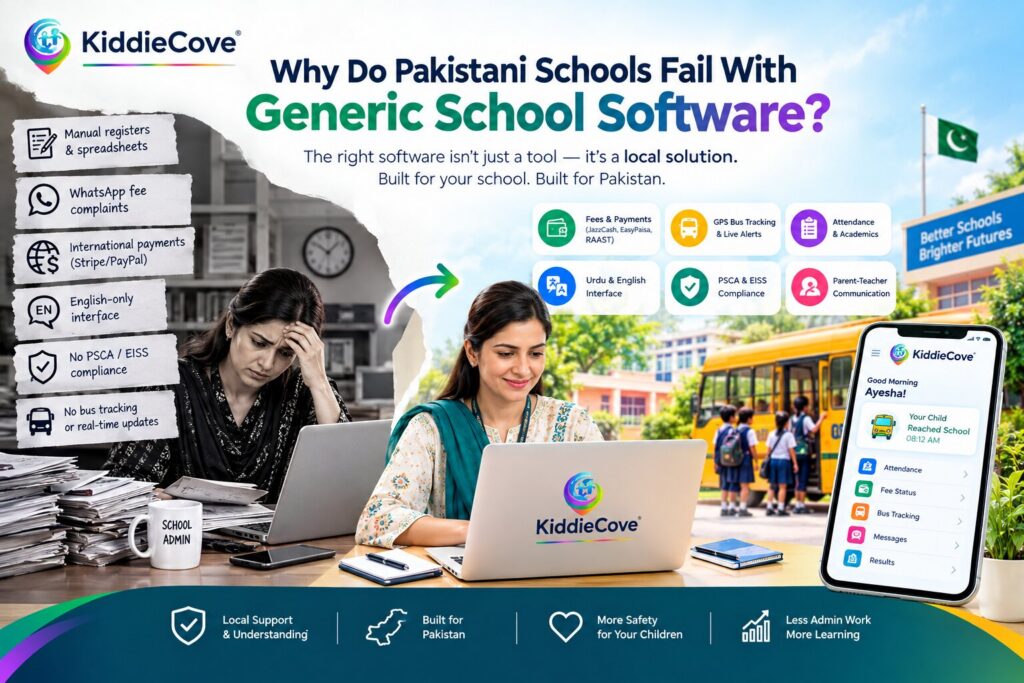
You run a school. Every morning, a teacher marks attendance in a register. The accounts clerk copies fee data into a spreadsheet. Parents send fee complaints on WhatsApp. A foreign software platform charges in US dollars and gives you an English-only interface that nobody on your staff fully understands. Sound familiar? You are not alone. Pakistan has over 144,000 private schools, and there are many schools that are not registered yet, and most of them face the exact same problem: the software they using it’s never built for them.
What Is Generic School Software, and Why Do Schools Try It First?
Generic school software is any platform built for a global market without Pakistan-specific features. You find it at international prices, with international payment systems and interfaces designed for schools in the UK or the US. Schools try it first for two reasons: the brand name sounds professional, and the price looks affordable up front. The real cost only shows up later, in wasted admin hours and broken fee collection.
Where Does Generic Software Break Down for Pakistani Schools?
You will hit the wall fast with a generic tool. You need to know exactly where it fails.
Payment gateways are the first wall. Parents in Pakistan expect to pay fees via JazzCash, EasyPaisa, or bank transfer. A generic school management software platform built for Stripe or PayPal gives your parents haven’t options they can’t actually use. Fee collection drops, defaults rise, and your accounts team chases money manually.
Compliance is the second wall. Punjab’s School Education Department has made the PSCA Public Safety App mandatory for all A, A-plus, and B category schools, with strict enforcement by District Education Officers. Furthermore, as of August 2026, the new EISS security system requires all Punjab schools to log digital security records through an official app or web portal. Generic tools cannot connect to any of these provincial mandates. You get non-compliance fines instead.
BISE exam formats are the third wall. Your school runs Matric, O-Level, or Cambridge tracks. Each board has its own result card format, grading scale, & reporting structure. A generic platform gives you one format. You end up customising manually every single term.
Urdu support is the fourth wall. Mostly parents in pakistan they read Urdu. The staff operates in Urdu. Generic platforms give you English-only dashboards. But at this time, many people speak English, but there is also a ratio of people who can not understand English, they read, speak and understand Urdu very well. You translate everything by hand, twice.
What Does Custom-Built School Software Actually Look Like?
Custom-built means built for Pakistan, from the ground up. You get JazzCash, EasyPaisa, and RAAST payment integration on day one. You get easy to understand nterface in both Urdu & English. You get PEIRA-ready fee disclosure and BISE-compatible result cards. You get GPS bus tracking that sends real-time alerts to parents the moment a child boards the school bus. KiddieCove is a clear example. It is Pakistan’s best child-safety-first school management system, trusted by 500+ schools across Karachi, Lahore, Islamabad, Rawalpindi and all over Pakistan.
You can read more about how KiddieCove handles school bus tracking in real time and our full fee management system built specifically for Pakistani schools.
How Is KiddieCove Better Than Generic Tools?
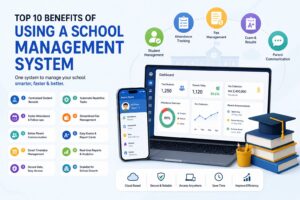
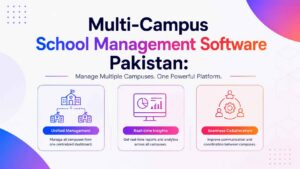
Why KiddieCove is the best choice in Pakistan, It connects directly to JazzCash, EasyPaisa, and RAAST, so parents pay the way they already pay. It sends instant pickup and drop alerts to parents through the app, replacing 30 unanswered WhatsApp messages with just a single notification. It works alongside the PSCA safety app mandate, so you stay compliant in Punjab without any extra work. It covers attendance, fees, results, school bus tracking, staff coordination, and parent communication in one dashboard. In short, all the thing which are related to students and teachers in one software. And it scales from a single-branch Montessori to a multi-campus school network without changing your workflow.
How Much Does Generic Software Actually Cost a Pakistani School?
There are a lot of school management systems in the market, and all are offering their own prices. A generic tool costs your admin staff 40+ hours per month in manual data re-entry. It costs you fee defaults from parents who cannot pay digitally. It costs you compliance fines when a DEO audit finds your safety records missing. It costs you parent trust every time someone calls to ask where the school bus is, and nobody can answer. The subscription looks cheap. The hidden cost is not.
What Should a Pakistani Principal Look for Before Choosing Software?
Before buying any tools, you need to check five things.
- JazzCash and EasyPaisa integration confirmed, not promised
- PEIRA fee disclosure and financial reporting built in
- Real-time GPS bus tracking with parent app alerts
- Urdu interface for staff and parent-facing screens
- PSCA and EISS compliance support for Punjab schools
Is Custom-Built School Software Affordable for Small Schools and Daycares?
You do not need to be a 10-campus school chain to afford this. KiddieCove runs on a subscription model, so you pay monthly without a high upfront cost. Small private schools, single-branch daycares, and Montessori institutions all use it across Pakistan. KiddieCove gives you lots of options like, in one tool, you can make different dashboards, add meeting details, and track different types of information. The entry cost is far lower than the cost of running manual registers, chasing fee defaulters, and managing compliance on paper.
The Bottom Line
Pakistani schools do not fail because their principals are not capable. They fail because they are trying to run a Pakistan-specific operation with tools built for someone else’s country. Custom-built software removes that gap. It speaks your language, accepts your payments, follows your regulations, and keeps your children safe. Book a free demo with KiddieCove and see what your school has been missing.