Your school day rarely breaks down because of teaching. It breaks down because the attendance register sits in one room, the fee ledger sits in another, and the marks sheet lives on a teacher’s laptop. Parents then ring the office for updates that nobody can find quickly, and your monthly report arrives after the decision has already been made.
You do not need a team to fix that. You need one application where student records, attendance, fees, exams, timetables, reporting & analytics, and parent messages live together.
What Is a School Management System?
A school management system is one platform that runs the daily work of your school. It holds academic records such as classes, subjects, timetables, exams and results. It also holds administrative and financial work, so admissions, staff files, fee invoices and receipts sit under the same login.
Communication sits on the same data, which means announcements, homework updates and parent messages travel through one channel. You can think of it as the front office, the staff room and the accounts department joined by a single database. A cloud-based school management system removes the need for separate registers, separate files and separate WhatsApp groups.
| Task | Manual method | Central system |
| Daily attendance | Paper register, counted at month end | Marked in under a minute, parent alerted the same morning |
| Monthly fees | Handwritten challan, cash count | Auto challan, online payment, live balance sheet |
| Result cards | Marks copied by hand twice | Marks entered once, card builds itself |
| School reports | Two or three days of tallies | Live dashboard |
10 Benefits of Using a School Management System
1. Put Every Student Record in One Place
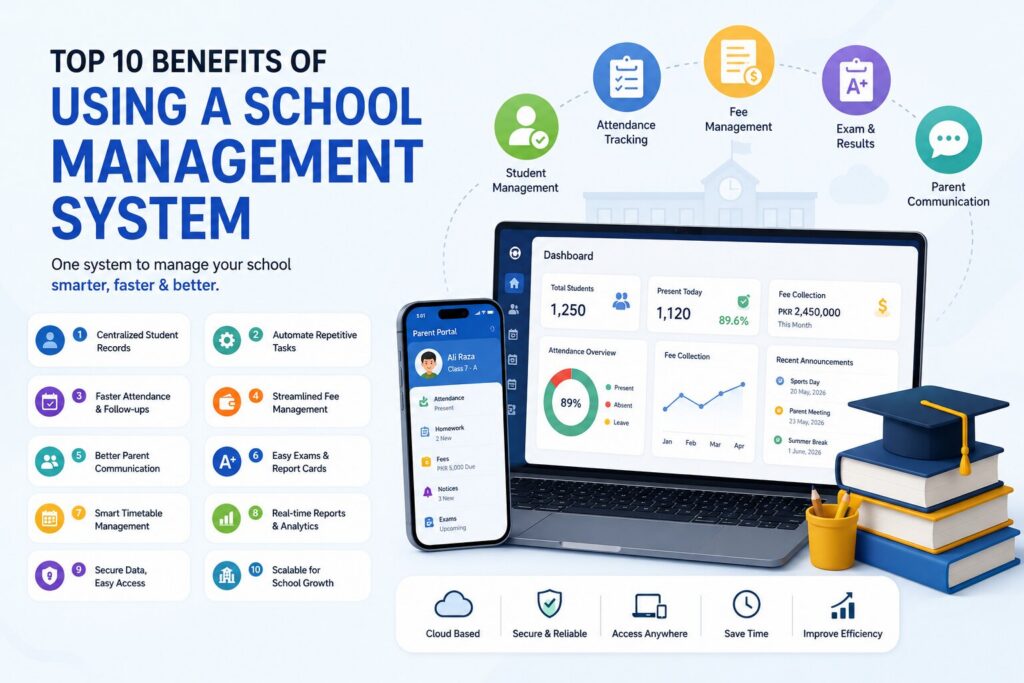
The student data usually sits in 4 or 5 places at once. One admission form, one register, one fee file, one result sheet, & none of them agree with each other. A central record ends the mismatch because every teacher and administrator reads and updates the same profile.
How often does a parent ask your office something that needs three phone calls to answer? A class teacher can instead open a child’s attendance, fee status and last term result on one screen. Duplicate entries drop too, and a move between sections no longer starts a fresh file.
2. Turn Repetitive School Tasks Into Automated Workflows
Admission forms, daily attendance, monthly challans, result cards & reminder messages follow the same steps every month. The system runs those steps on a rule you set once, and your staff handles only the exceptions.
Teachers across OECD school systems report roughly three hours a week on administrative work, and heavy admin load ranks among the top sources of teacher stress in the TALIS 2024 findings. Every hour you clear goes back to the classroom.
3. Make Attendance Faster, and Follow Up Sooner
Digital attendance takes a teacher under a minute per class. Absences are recorded at once, so a parent hears the same morning rather than at the end of term. You also see the pattern, because the system counts repeat absentees for you.
4. Stop Chasing Fee Records and Payment Updates
Fee work is where most school offices lose their week. The system generates challans on a schedule, records each payment against the right student, issues a receipt, and lists outstanding balances by class. Parents pay fees online through their local banks like JazzCash, Easypaisa, and Local Banks, so you don’t need to hire a person who can count cash and manage salaries.
Payment habits in Pakistan already support the shift. Digital channels carried 92 per cent of the country’s 3.7 billion retail banking transactions between January and March 2026, per the State Bank of Pakistan. Your parents already pay utility bills on a phone, so online fee collection is the obvious next step.
5. Keep Parents Connected Without Endless Calls and Messages
Parents want three answers. Did my child reach school? What is the homework? and what is due next week? A parent app answers all these without a phone call, because attendance, homework, notices and event dates are published straight to the parent’s screen.
One announcement replaces forty scattered messages, and the record stays searchable when a dispute comes up months later. A structured parent-teacher chat also protects your teachers from after-hours calls on personal numbers.
6. Take the Stress Out of Exams, Marks, and Report Cards
Exam season is your heaviest paperwork of the year. You schedule papers, collect marks from every teacher, apply the grade scale, then print result cards for hundreds of students. The system handles the arithmetic and the format, so a teacher enters a mark once and the report card builds itself.
7. Build Timetables Without the Usual Scheduling Chaos
Timetable work punishes schools every term. One teacher gets booked for two sections in the same period, a lab sits empty, and the correction never reaches all four printed copies. A central timetable flags the clash at the moment you assign the slot.
A change then publishes to teachers, students & parents at once. Academic calendars sit in the same place, so holidays, exam weeks and sports days never contradict the class schedule.
8. Replace Guesswork With Real-Time School Reports
A dashboard shows today’s attendance percentage, this month’s fee collection, live admission numbers and subject-level results without a single manual tally.
Decisions then get sharper. A section with falling attendance gets a counsellor, a class with weak maths results gets extra periods, and a collection shortfall triggers a reminder run before payroll week.
9. Protect School Data While Making It Easier to Access
You decide what a class teacher sees, what an accountant sees, and what a parent sees. Cloud backups keep a copy off-site, so a stolen laptop or a damaged register no longer erases a year of records.
No vendor can honestly promise perfect security, so you should ask instead about role permissions, backup frequency, encryption, and who holds the master admin rights.
10. Reduce Administrative Work as the School Grows
Growth is where manual systems break first. Two hundred students fit inside a register, and twelve hundred students across three campuses do not.
A central platform absorbs more students, staff, classes and departments without the matching weight of files. Multi-campus schools feel the difference most, because head office reads every branch from one dashboard.