
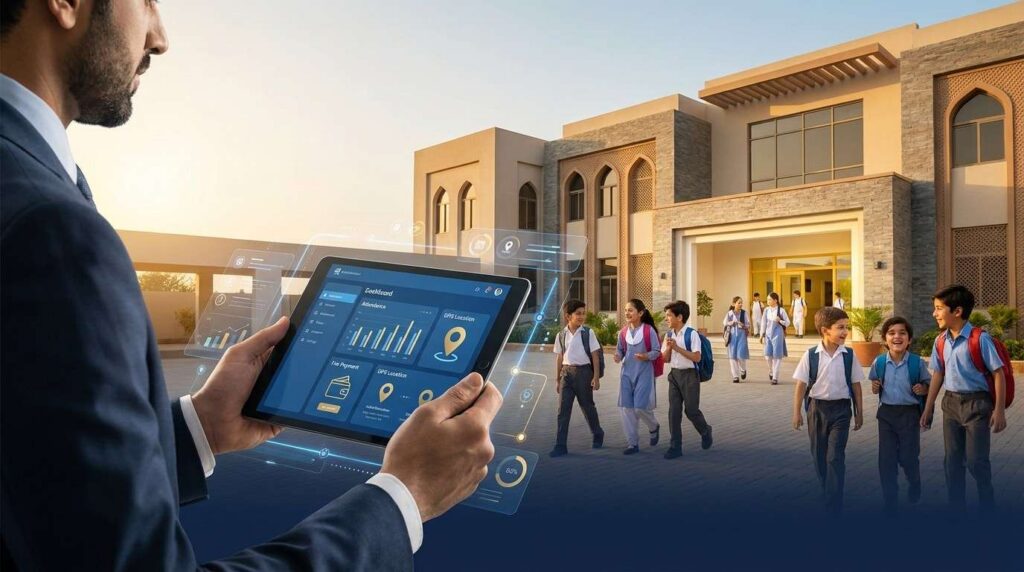
Pakistani Schools owners are not adopting a school management system because it is a trend. They are doing it because manual administration has specific measurable costs that have become harder to ignore in 2026. Fee defaults pile up without automated follow up. Admin staff spend days each term compiling reports that should take minutes.
Punjab schools face a new legal directive that requires GPS tracking for all school transport. Parents with smartphones expect attendance alerts and online fee payment as standard. This article covers seven concrete reasons why Pakistani schools are making the switch, with the numbers that make each reason impossible to dismiss.
The Challenge Facing Pakistani School Owners in 2026
Pakistan has over 150,000 registered private schools. The sector is competitive. Parents in most cities have several credible options within a few kilometers of their home. The schools that retain students and attract new families are not always the ones with the best teachers. They are often the ones that communicate better collect fees without friction, and demonstrate to parents that their child’s safety is being actively monitored.
At the same time the cost of running a school manually is rising. Qualified admin staff are harder to retain. The PSCA directive has added a compliance requirement that cannot be met with spreadsheets. Pakistani parents, most of whom now carry a smartphone have started comparing the digital experience offered by different schools before making enrollment decisions.
A school management system does not solve every challenge a school owner faces. But for these seven specific problems, it is the most direct and cost-effective solution available.
Reason 1: Digital Fee Collection via JazzCash, EasyPaisa, and RAAST Reduces Monthly Defaults
Manual fee collection creates a structural problem. Parents who cannot visit the school office during working hours simply delay payment. There is no automated reminder. The accountant’s follow-up list grows. By mid-term, the outstanding amount is too large to recover without uncomfortable conversations.
A school management system connects your fee records directly to JazzCash, EasyPaisa, RAAST, and 1Link. The parent receives their fee challan in the app. They pay from their wallet or bank account without visiting the school. The system records the transaction, generates a digital receipt, and removes the student from the outstanding list in real time.
The system also sends automated SMS reminders at intervals you configure three days before the deadline on the deadline date, and three days after. A parent who forgot to pay receives a reminder before the amount becomes overdue. The admin team only gets involved for the small percentage of cases that genuinely need a personal conversation.
For a school with 400 students and a conservative 5% monthly default rate, that is 20 families generating unpaid fees every month. A school management system that reduces that rate to 1% recovers the cost of the subscription from the first month alone.
Reason 2: Real-Time Attendance Alerts Remove the Need for Daily Parent Phone Calls
A school that does not send attendance alerts creates a specific problem: parents call the school office to ask whether their child arrived. On a typical day, an admin staff member in a 500-student school handles 15 to 30 inbound calls about attendance. That is time that could be spent on productive work.
The root cause is not demanding parents. It is the absence of a reliable channel for sending real-time information outward from the school to parents.
A school management system gives every teacher a phone-based attendance tool. The teacher marks attendance at the start of each class. If a student is absent, the system sends an automated SMS to the parent within minutes. The parent does not need to call, because the information already reached them.
Parents also have access to their child’s full attendance record in the parent app at any time. This transparency reduces anxiety, reduces inbound calls, and gives the school a clear audit trail if any dispute arises later.
Reason 3: The PSCA April 2026 Directive Made GPS Tracking a Legal Requirement for Punjab Schools
This is the reason that has moved the largest number of Punjab school owners from consideration to action in the first half of 2026.
The Punjab Safe Cities Authority issued a student safety directive in April 2026 requiring all public and private schools in Punjab to implement GPS-verified tracking of students during transport hours. The directive covers route logging, child handover records, and parent notification. Schools that cannot demonstrate compliance face inspection penalties.
GPS tracking is not something a school can implement by purchasing a device and plugging it into a van. It requires a software system that receives the GPS signal, stores the route data, provides a live map to parents, and generates the compliance logs that an inspection officer can review.
KiddieCove is the only school management system in Pakistan that includes built-in PSCA compliance support as part of its core platform. No third-party app is required. No separate hardware subscription is needed beyond the GPS unit in the vehicle. The route logs and handover records are generated automatically and stored for the required period.
For Punjab schools, this reason alone is sufficient to justify adopting a school management system before the end of the current academic year.
Reason 4: Automatic Report Cards Save Admin Staff Up to Three Days Per Term
At the end of every term, most Pakistani school admin teams go through the same process. Attendance records are collected from each class teacher. Marks are gathered from subject teachers, often via WhatsApp messages or handwritten notebooks. The data is entered into an Excel template. Formatting is corrected. Errors are fixed. Report cards are printed. The process takes two to four days of focused admin work depending on the number of students.
A school management system eliminates this process almost entirely. Teachers enter marks and attendance into the system throughout the term. When the term ends, the admin staff clicks generate. The system produces a formatted report card for every student from the data that already exists in the system.
The report card format is configured once by the school. It applies automatically to every student in every class every term. Three days of admin time per term is six days per year. At the salary of a senior admin staff member, that is a significant recurring cost that a school management system eliminates.
Reason 5: A School Management System Typically Pays for Itself Within the First Month
School owners who are cautious about technology spending ask a reasonable question what is the return on this investment?
The calculation for a school management system is more straightforward than most software investments. Take fee recovery. If a school with 400 students currently loses PKR 25,000 per month to defaults and late payments, and a school management system with automated reminders and online payment reduces that loss to PKR 5,000 per month, the system has saved PKR 20,000 per month. A mid-range subscription for a 400-student school costs PKR 5,000 to PKR 7,000 per month. The system pays for itself from fee recovery alone.
Add the time saved on attendance reports, termly report cards, parent communication, and timetable management, and the total return in the first year is several times the subscription cost.
There is also an enrollment effect. Schools that offer online fee payment, attendance alerts, and GPS transport tracking are more competitive for new student inquiries. If a school management system helps retain two students who would otherwise have transferred to a more digital competitor, the fee revenue from those two students covers the annual subscription cost many times over.
Reason 6: Parents Now Compare Schools on the Quality of Their Digital Communication
Five years ago, Pakistani parents chose a school based on academic reputation, fees, and location. In 2026, a fourth factor has entered the decision: how well the school communicates and how much visibility parents have into their child’s day.
This shift is driven by smartphone adoption. Pakistani parents in cities and major towns are now almost universally connected. They use JazzCash and EasyPaisa for everyday transactions. They expect app-level responsiveness from any organisation they interact with regularly. When they call a school to ask whether their child is present, and the answer is ‘we will check and call you back,’ they notice. When they pay fees by standing in a queue at the school office, they notice.
Schools that use a school management system to send automatic attendance alerts, offer online fee payment, and give parents a live view of school transport are meeting an expectation that is becoming standard. Schools that do not are falling behind a bar that their competition is already clearing.
This does not mean that parents choose a school based on its software. It means that all other things being equal, a school with a modern communication system retains families more reliably and generates more positive word of mouth from satisfied parents.
Reason 7: Running Multiple School Branches from One Dashboard Is Not Possible Without a Central System
A school group with two or three branches faces a specific administrative problem. Each branch has its own fee register. Each branch has its own attendance system, which may be a notebook, an Excel file, or a WhatsApp group. Getting a complete picture of how the school group is performing requires someone to manually collect data from every branch and reconcile it.
This process is slow, error-prone, and entirely dependent on the person who does the reconciliation. If that person is absent, the information gap widens. If they leave the school, institutional knowledge about how the reconciliation works leaves with them.
A school management system with multi-branch support solves this at the root. All branches operate on the same platform. Fee collection, attendance, academic records, and transport tracking for every campus appear in a single dashboard. The school owner sees the full picture of every branch in real time without needing to ask anyone.
Branch-level access controls mean that a branch principal sees only their campus. The central admin sees everything. Reports can be generated for individual branches or for the full group. This is not replicable with spreadsheets at any meaningful scale.
Why Pakistani Schools Specifically Choose KiddieCove School Management System
There are several school management systems available in Pakistan. KiddieCove stands out for three specific reasons:
| Differentiator | What It Means for Your School |
| Built for Pakistan | Supports JazzCash, EasyPaisa, RAAST, 1Link natively. Works on 3G data. SMS in formats that work on basic phones. |
| GPS and PSCA compliance included | No third-party app. No separate hardware subscription. Route logs stored automatically for inspections. |
| Priced for Pakistani schools | Per-student pricing in PKR. Starts at PKR 3,000/month. No large upfront fees. Free trial available. |
Book a call for School Management System
Frequently Asked Questions
Q1: Why do Pakistani schools need a school management system in 2026?
Pakistani schools need a school management system in 2026 for three main reasons: the PSCA April 2026 directive requires GPS tracking for Punjab school transport, parents now expect real-time digital updates on fees and attendance, and manual administration costs schools significant time and money each month. A school management system addresses all three at once.
Q2: How does a school management system help with fee collection in Pakistan?
A school management system connects directly to JazzCash, EasyPaisa, RAAST, and 1Link, so parents pay fees from their phone without visiting the school cashier. The system automatically records each transaction, generates digital receipts, and sends reminders before and after every deadline. This reduces monthly fee defaults without any manual follow-up by staff.
Q3: What is the PSCA directive and which schools does it apply to?
The PSCA (Punjab Safe Cities Authority) student safety directive, issued in April 2026, requires all public and private schools in Punjab to implement GPS-verified student transport tracking. Schools that do not comply face regulatory penalties. KiddieCove’s built-in GPS module satisfies this requirement without any additional hardware or third-party app.
Q4: Does a school management system make financial sense for small private schools in Pakistan?
Yes. For a school with 400 students and a 5% monthly fee default rate, recovering just half of those defaults covers the entire cost of a school management system subscription. Most schools see a positive financial return within the first month of using KiddieCove.
Q5: How does KiddieCove differ from other school management systems available in Pakistan?
KiddieCove is the only school management system in Pakistan that combines JazzCash/EasyPaisa/RAAST fee collection, real-time GPS student tracking, built-in PSCA compliance reporting, automated report cards, and a parent mobile app in one platform designed for Pakistani schools.
Q6: Can a school management system help Pakistani schools compete for student enrollment?
Yes. Pakistani parents increasingly compare schools based on the quality of their digital communication. Schools that send automated attendance alerts, offer online fee payment, and provide GPS transport tracking are more likely to retain existing families and attract new enrollments from schools still using manual systems.
Q7: How long does it take for a Pakistani school to set up a school management system?
Most schools complete the initial setup of KiddieCove within 7 to 14 days. This includes importing student records, configuring fee structures, connecting payment gateways, and training admin staff. The fee collection and attendance modules can be live within the first week.