The Complete Of School Management System 2026 Guide for Schools, Academies & Education Networks
Last updated: 15 May 2026 • Reading time: 14 minutes
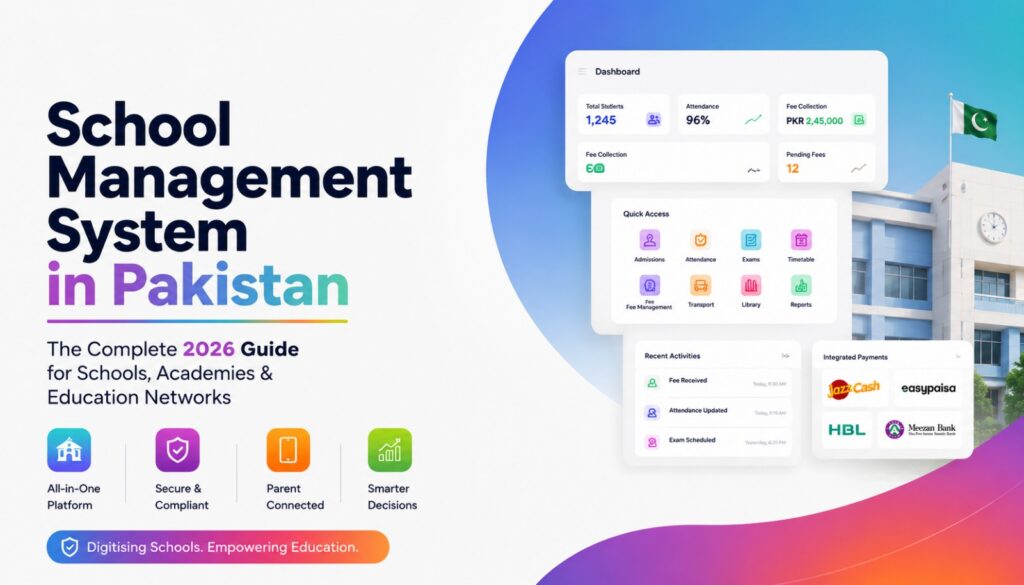
A school management system in Pakistan is end-to-end school administration software that digitises every operation a school runs daily admissions, attendance, fee collection, exams, gradebook, timetable, transport, library, payroll, and parent communication inside one secure, cloud-based platform. For Pakistani schools, the right system also integrates JazzCash, EasyPaisa, HBL, and Meezan Bank for fee payments, supports Urdu and English interfaces, and complies with the Pakistan Personal Data Protection Bill and the FBISE / provincial board examination formats.
This guide is written for principals, school owners, IT coordinators, and directors of education networks across Pakistan from a single branch in Karachi or Lahore to multi-campus chains operating in Islamabad, Rawalpindi, Faisalabad, Multan, Peshawar, and Quetta. By the end, you will know exactly what a modern school ERP must include in 2026, how to evaluate vendors, what implementation actually costs in PKR, and how to roll the system out without disrupting an academic term.
1. What is a School Management System?
A school management system (also called school management software, school ERP system, or education management system) is a unified digital platform that automates the administrative, academic, financial, and communication workflows of a school. Modern systems are delivered as cloud-based SaaS accessible from any browser or mobile app and replace the patchwork of registers, spreadsheets, WhatsApp groups, and standalone accounting tools that most Pakistani schools still rely on.
At its core, a complete school operating system answers four questions every school leader asks daily:
- Who is in school today? Real-time attendance for students and staff, with biometric, RFID, or app-based check-in.
- Who has paid, and who owes? Live fee ledgers with JazzCash, EasyPaisa, HBL, and bank-transfer reconciliation.
- How is each child performing? Continuous gradebook tied to the Single National Curriculum (SNC), FBISE, or O/A-Level scheme of studies.
- Are parents engaged? One-click SMS and WhatsApp notifications, plus a parent portal and mobile app.
A purpose-built student information system (SIS) sits inside this, holding the complete academic profile of every learner admissions data, attendance, marks, behaviour notes, health records, and parent contact details and feeds every other module of the platform.
In one sentence: A school management system replaces 12 disconnected tools with one secure platform that runs your school.
2. School ERP vs SIS vs Campus Management Software: Clarifying the Terminology
These terms are often used interchangeably, but in procurement decisions the differences matter. Use this table when comparing vendors:
| Term | Primary Focus | Best Suited For |
| School Management System | Day-to-day school administration: attendance, fees, exams, communication | Single-campus primary, middle, and secondary schools |
| School ERP System | Deep operational + financial modules: payroll, inventory, accounting, HR | Larger schools with finance teams and ≥500 students |
| Student Information System (SIS) | Academic record-keeping: admissions, transcripts, grades, certificates | Schools prioritising academic data and board reporting |
| Campus Management Software | Multi-campus orchestration: branches, central reporting, group dashboards | School chains, franchise networks, university-affiliated campuses |
| School Administration Software | Office workflows: front desk, leave, circulars, asset tracking | Schools digitising administrative paperwork first |
| School Operating System | All of the above as one unified, API-connected platform | Modern schools wanting a single source of truth |
KiddieCove delivers a unified school operating system that ships with full SIS, school ERP, and campus management capability growing schools do not need to migrate platforms when they expand from one branch to many.
3. Why Pakistani Schools Need a School Management System in 2026
Pakistan’s K-12 sector is at an inflection point. The combination of post-COVID parent expectations, rapidly increasing private-school competition, and government digitisation pressure has made manual administration unsustainable.
1. Parents now expect real-time visibility.
A parent in DHA Karachi or Bahria Town Lahore today expects to see attendance, homework, exam marks, and fee status on a phone the same way they track a Foodpanda order. Schools that cannot deliver this lose admissions to those that can.
2. Fee collection has moved digital.
State Bank of Pakistan’s Raast instant payment system, plus mature mobile wallets like JazzCash and EasyPaisa, mean cash-counter queues are obsolete. Schools using digital collection report dramatically lower fee defaults because parents can pay any time, from anywhere.
3. Boards and regulators are digitising.
FBISE, BISE Lahore, BISE Karachi, and the Punjab School Education Department (PSED) increasingly require structured digital submissions. Schools running on registers and Excel struggle to meet these formats at deadline.
4. Staff retention depends on tools.
Teachers in Pakistan are over-burdened with non-teaching admin marking attendance registers, calculating result cards, calling parents. A school management system removes 6–10 hours of weekly clerical work per teacher, directly improving retention.
5. Multi-campus expansion is the norm.
Chains like Beaconhouse, The City School, LGS, Roots, Bay View, Bloomfield Hall, and Generation’s already run multi-campus operations but mid-sized schools in Tier-2 cities (Sialkot, Gujranwala, Sargodha, Hyderabad, Sukkur, Abbottabad) are now opening second and third branches and need campus management software from day one.
4. Pakistan Market Snapshot
According to the Pakistan Education Statistics report published by the Pakistan Institute of Education (Ministry of Federal Education and Professional Training), Pakistan has more than 300,000 educational institutions serving over 55 million enrolled learners, with approximately 35% of enrolment in private schools a share that has grown consistently for the past two decades. ASER Pakistan and UNICEF Pakistan further estimate that roughly 22.8 million children remain out of school, the second-highest figure globally, which is why education-technology adoption is a national priority articulated in the National Education Policy framework.
For private and trust-based schools the segment most likely to invest in school management software three structural realities define the buying decision:
- Cost sensitivity: Tuition fees in Pakistan are dramatically lower than in Gulf or Western markets, so SaaS pricing must be calibrated in PKR per student per month, not USD per seat.
- Connectivity variance: Urban centres have 4G and fibre, but Tier-3 cities still see intermittent connectivity. A serious school operating system must work offline-first and sync when online.
- Language and script: Schools serving Urdu-medium and Cambridge streams need bilingual interfaces, RTL support for Urdu communication, and parent SMS templates in both scripts.
These constraints rule out most generic, US-built school management systems. Schools in Pakistan need software that is built for, priced for, and supported in Pakistan.
5. Core Features Every School Operating System Must Have
A complete school management software for the Pakistani market in 2026 must include the modules below. Anything less is a partial solution that will force you to buy point tools and re-integrate them later.
- Admissions & Student Information System (SIS). Online admission forms, document upload, applicant scoring, waitlist management, and one-click conversion to enrolled student records. Holds every learner’s profile, family details, medical info, prior-school records, and consents.
- Attendance Management. Daily class-wise attendance with biometric (fingerprint, face), RFID, or teacher-app input. Auto-SMS to parents on absence within 30 minutes of first period. Staff attendance with shift, leave, and overtime tracking.
- Fee Management & Online Payments. Configurable fee heads, discounts, scholarships, sibling concessions, and late-fee rules. Integrated JazzCash, EasyPaisa, HBL, Meezan Bank, 1Bill, and Easypay, plus printable challans. Automated reminders 7, 3, and 1 day before due date.
- Gradebook, Exams & Result Cards. Continuous assessment, term exams, custom marking schemes for FBISE, provincial boards, Cambridge IGCSE/O/A-Level, and Aga Khan University Examination Board. Auto-generated, board-formatted result cards.
- Timetable & Substitution Management. Drag-and-drop timetable builder with teacher-load balancing, room conflict detection, and one-click substitution when a teacher is absent.
- Parent Portal & Mobile App. Native iOS and Android parent app with attendance, homework, exam results, fee status, event calendar, photo gallery, and direct teacher messaging. WhatsApp Business API integration for circulars and reminders.
- Teacher App. Mobile-first teacher experience: mark attendance, upload homework, enter marks, message parents, request leave, and view payslips. Works offline and syncs when connectivity returns.
- Communication Hub. Bulk SMS via local aggregators, WhatsApp Business templates, email, and in-app push notifications. Pre-built templates for absence alerts, fee reminders, exam schedules, and holiday announcements.
- Library Management. Catalogue, issue, return, fine calculation, and reservation. Barcode-based check-out and lost-book tracking.
- Transport Management. Route planning, vehicle assignment, driver records, and live GPS tracking for parent app. Pick-up and drop-off SMS notifications.
- HR, Payroll & Accounting (School ERP). Staff records, leave management, payroll with EOBI and PESSI calculations, income-tax slabs as per FBR, and integrated double-entry accounting.
- Multi-Campus / Campus Management Layer. Central dashboard for school chains: cross-campus enrolment, financial consolidation, comparative academic reports, and group-level fee policy enforcement.
- Reports & Analytics. Pre-built reports for principals, teachers, and owners. Custom report builder for board submissions.
- Data Security & Compliance. End-to-end encryption in transit and at rest, role-based access control, audit logs, daily backups, alignment with the Pakistan Personal Data Protection Bill.
6. Benefits by Stakeholder
A school management system only succeeds when it solves a real, daily problem for every person who touches it.
For the Principal / School Owner. One dashboard replaces 12 manual reports. You see live admission count, fee collection percentage, today’s attendance, and pending salaries in 30 seconds — at 7 a.m. before assembly.
For Teachers. Attendance in 90 seconds instead of 10 minutes. Result cards generated automatically instead of late nights with a calculator. Parent communication through one app instead of personal WhatsApp numbers.
For Parents. Real-time answers without calling the school office. Pay fees from a phone at 11 p.m. View today’s homework, tomorrow’s test schedule, and the bus location. Receive instant alerts when a child arrives at and leaves school.
For Students. Homework, test dates, study material, and report cards in one app. For senior students, a transparent view of attendance percentage and exam performance — building accountability.
For Accountants. Automated fee ledgers, reconciliation against bank statements, daily collection summaries, and one-click generation of vouchers and audit-ready reports. Reduces month-end close from 5 days to 1.
For IT Coordinators. No servers to maintain, no Excel files to back up. Role-based access means the front-desk officer cannot see payroll, the accountant cannot edit grades, and only authorised admins can change fee structures.
7. How to Choose the Right School Management Software in Pakistan
Use this 12-point evaluation framework. Score each vendor out of 5 — anything below 48/60 is not ready for your school.
- Built for Pakistan? Supports JazzCash/EasyPaisa, FBISE/board formats, EOBI/FBR payroll rules, and Urdu language.
- Cloud-based and mobile-first? Native iOS + Android apps for parents and teachers — not just a responsive website.
- Multi-campus capable? Even if you have one branch today, your platform should not become an obstacle to growth.
- Offline-first for attendance? Teachers must be able to mark attendance during a power cut and sync later.
- API and integrations? Open APIs for accounting (QuickBooks, Xero), HR, LMS (Google Classroom, Microsoft Teams).
- Implementation time? A serious vendor goes live in 30–60 days, not 6 months.
- Training and support? On-site training included; dedicated WhatsApp/phone support during Pakistan business hours.
- Reference customers in Pakistan? Ask to speak to two existing customers of similar size in your city.
- Data ownership and export? You own your data and can export everything in CSV/SQL at any time.
- Security posture? Encryption, RBAC, daily backups, and a published security policy.
- Transparent pricing in PKR? Per-student-per-month with no hidden setup, training, or upgrade fees.
- Roadmap and updates? Quarterly releases with new features included in your subscription.
8. Implementation Roadmap: 30 / 60 / 90 Days
A realistic deployment for a 500–1,500 student school in Pakistan follows this schedule:
Days 1–14: Discovery & Data Migration. Vendor audits current registers, fee structure, staff list, and last academic year’s data. Existing data is cleaned and imported.
Days 15–30: Configuration & Training. Fee heads, classes, sections, timetables, and user roles are set up. Train-the-trainer for senior staff. Teacher and accountant training in batches.
Days 31–45: Parallel Run. New system runs alongside existing registers/Excel for two to three weeks. Daily reconciliation catches edge cases.
Days 46–60: Go Live. Cutover to the school management system as the system of record. Parent app launched with onboarding SMS and tutorial video.
Days 61–90: Optimisation. Reports tuned, automation rules refined, second-wave features switched on. First management review with quantified savings.
9. Pricing Reality in Pakistan (PKR)
School management software pricing in Pakistan is typically structured in three ways:
- Per-student-per-month (PSPM): Most common SaaS model. Roughly PKR 50–300 PSPM depending on modules, support level, and campus count. Volume discounts above 1,000 students.
- Flat annual licence: Some legacy vendors offer a fixed PKR licence fee per campus per year. Often hides scope limitations.
- One-time + AMC: On-premise installation with an annual maintenance contract. Increasingly rare and not recommended for schools under 5,000 students.
A 600-student school in Lahore on a modern cloud school operating system typically invests PKR 50,000 to PKR 150,000 per month equivalent to roughly the cost of one administrative staff member, while saving the workload of three. Implementation, training, and standard support are usually included; payment-gateway transaction fees (1.5–2.5% per JazzCash/EasyPaisa transaction) are passed through.
Budgeting rule of thumb: Total cost of ownership of a quality school management system should sit between 0.5% and 1.5% of annual tuition revenue.
10. The KiddieCove Difference
KiddieCove is a school management system built in Pakistan, for Pakistan. Every design decision — from JazzCash and EasyPaisa integration on day one, to bilingual Urdu-English interfaces, to FBISE-formatted result cards, to offline-first attendance for load-shedding hours reflects how Pakistani schools actually operate.
What makes KiddieCove different from generic or imported platforms:
- Local payment rails: Native integrations with JazzCash, EasyPaisa, HBL, Meezan Bank, and 1Bill — not bolt-on plugins.
- Pakistan-compliant payroll: Built-in EOBI, PESSI, and FBR income-tax-slab calculations.
- Board-ready reports: Result cards and submissions formatted for FBISE, BISE Lahore, BISE Karachi, BISE Rawalpindi, Aga Khan Board, and Cambridge.
- WhatsApp Business API: Pakistan’s most-used channel, integrated for circulars and one-to-one parent messaging.
- Karachi-based support: Phone, WhatsApp, and on-site support during Pakistan business hours, in English and Urdu.
- Transparent PKR pricing: Per-student-per-month, no surprise charges, no forced upgrades.
- Implementation in 30–60 days: Live before your next academic term begins.
KiddieCove is used by schools across Karachi, Lahore, Islamabad, Rawalpindi, Faisalabad, Multan, Peshawar, Quetta, Sialkot, Gujranwala, and Hyderabad — from single-branch primary schools to multi-campus secondary networks.
11. Frequently Asked Questions
Q1. What is the best school management system in Pakistan in 2026?
The best school management system in Pakistan is one that natively integrates JazzCash and EasyPaisa, supports FBISE and provincial board result formats, offers bilingual Urdu-English interfaces, and delivers parent communication over WhatsApp. KiddieCove is purpose-built for Pakistani schools and meets all of these requirements, with implementation in 30–60 days and per-student-per-month pricing in PKR.
Q2. How much does school management software cost in Pakistan?
School management software in Pakistan typically costs between PKR 50 and PKR 300 per student per month, depending on the modules, number of campuses, and support level. A 600-student school usually invests PKR 50,000–150,000 per month for a complete cloud-based school operating system including parent app, payment integrations, training, and support.
Q3. What is the difference between a school management system and a school ERP?
A school management system covers day-to-day school operations — attendance, fees, exams, and communication. A school ERP adds deeper finance, payroll, HR, inventory, and procurement modules. Modern platforms like KiddieCove ship both together as a single school operating system, so growing schools do not need to migrate later.
Q4. Can a school management system work offline during load-shedding?
Yes — a modern school management system should be offline-first for the teacher and attendance apps. Data is captured locally on the teacher’s phone or tablet and syncs to the cloud automatically when connectivity returns, ensuring attendance and classwork are never lost during power or internet interruptions.
Q5. Does the school management system support FBISE and provincial board result formats?
A Pakistan-built school management system should support FBISE, BISE Lahore, BISE Karachi, BISE Rawalpindi, Aga Khan University Examination Board, and Cambridge marking schemes out of the box, with auto-generated result cards in each board’s official format. Confirm this with the vendor before signing the contract.
Q6. How long does it take to implement a school management system in a Pakistani school?
A realistic implementation for a 500–1,500 student school in Pakistan takes 30 to 60 days. This includes discovery, data migration from registers and Excel, configuration, staff training, a two-to-three-week parallel run with existing systems, and go-live. Schools opting for the parent app and full feature roll-out reach steady state by day 90.
Q7. Is parent and student data safe with a cloud-based school management system?
A reputable school management system encrypts data in transit and at rest, enforces role-based access control, maintains daily backups, and aligns with the Pakistan Personal Data Protection Bill. Hosting on Pakistan-based or compliant regional data centres adds data sovereignty. Always ask the vendor for their published security and data-handling policy before signing.
Q8. Can the school management system handle multi-campus or franchise operations?
Yes — a complete campus management software platform provides a central dashboard for school chains, consolidating enrolment, fee collection, academic performance, and HR across all branches. KiddieCove supports unlimited campuses under one group account.
Q9. Does the school management system integrate with JazzCash, EasyPaisa, and bank challans?
A Pakistan-ready school management system must natively integrate JazzCash, EasyPaisa, HBL, Meezan Bank, 1Bill, and Easypay, and also generate printable challans for over-the-counter banking. KiddieCove ships with these integrations on day one.
Q10. What is a student information system (SIS) and do I need one separately?
A student information system (SIS) is the academic record-keeping core of a school platform — it holds every learner’s admissions data, attendance, grades, transcripts, behaviour notes, and family details. A complete school management system like KiddieCove includes a full SIS, so you do not need to buy or integrate a separate product.
12. Get a Free Demo
Schedule a 30-minute personalised demo with KiddieCove’s Pakistan team. We will walk you through your exact scenario single branch or multi-campus, primary or secondary, FBISE or Cambridge — and share a written PKR proposal for your school.
Sources & Further Reading
- Pakistan Institute of Education: Pakistan Education Statistics.
- ASER Pakista: Annual Status of Education Report.
- UNICEF Pakistan: Education situation analysis.
- Federal Board of Intermediate: Secondary Education (FBISE).
- State Bank of Pakistan: Raast instant payment system.